Three-Candle Continuation: Identify the Next Push
Recognize a push, contained pullback, and renewed push, then use green-red-green or red-green-red sequences to read bullish or bearish continuation.
In brief
- Rule type
- TradeGlean teaching screen; not a universal pattern definition or a verified trading edge.
- Direction
- Bullish sequence resumes an uptrend; bearish sequence resumes a downtrend.
- Role / context
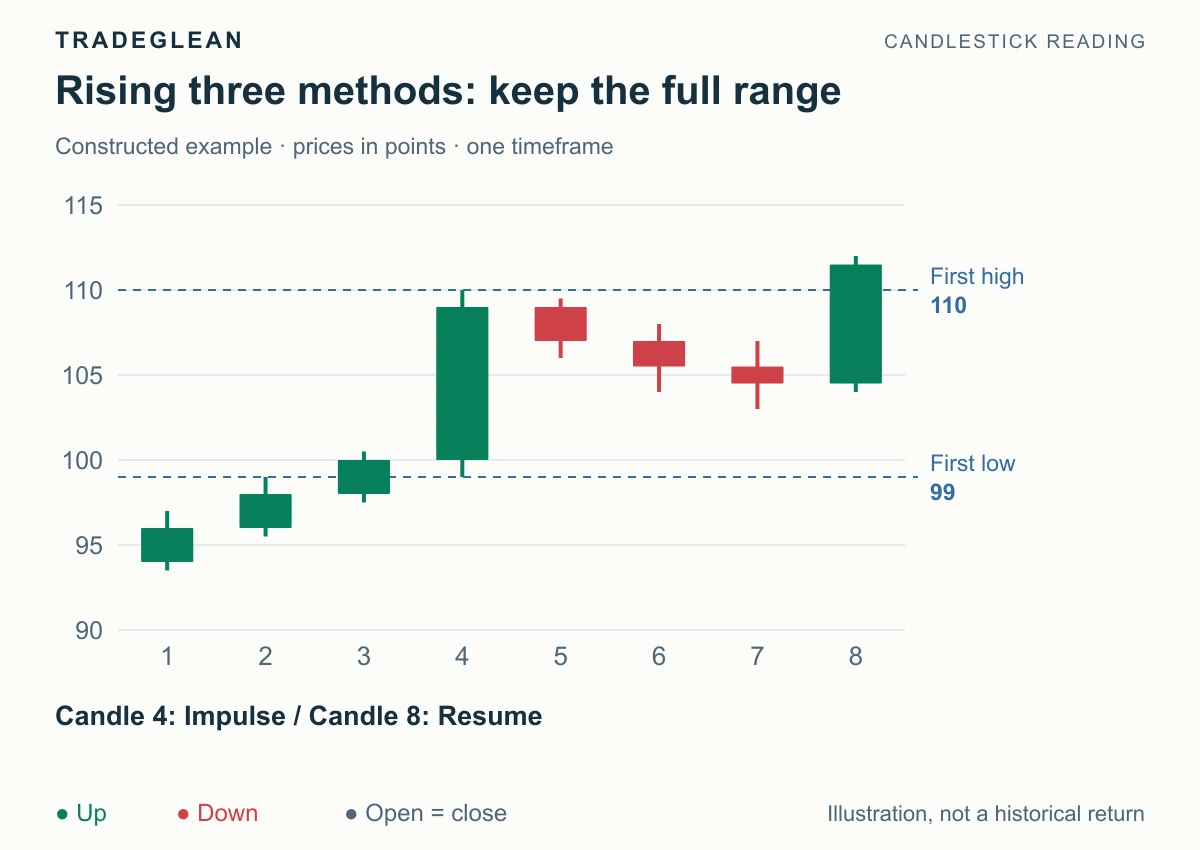
- Three-candle continuation, not the traditional five-candle three methods.
- Main trigger
- Main bullish example: third candle closes above the first push high at 104.
- Cancel when
- Use the full bullish structure low at 99.5; reverse the full-range rule for the bearish case.
- Next decision
- Before the final close, the sequence is only developing.
Before you read · terms and starting articles
New to a term? Open the trading glossary.
Candlestick Reading for Beginners
Browse the articles
Begin with anatomy and context
Single-candle signals
- Doji and Spinning Tops: Read the Pause, Then the BreakBeginner · 5 min read
- Dragonfly and Gravestone Doji: Bullish vs. Bearish SignalsBeginner · 5 min read
- Hammer vs. Hanging Man: Identify the Shape and DirectionBeginner · 5 min read
- Shooting Star vs. Inverted Hammer: Which Way to Read It?Beginner · 5 min read
Reversal combinations
Momentum and continuation
Connect the signal to risk
In this article
A contained pullback followed by a new push favors continuation
In an uptrend, a strong green candle, a smaller red pullback, and a green close above the first candle's high form a bullish continuation setup. In a downtrend, use the mirror: red push, contained green rebound, then a red close below the first candle's low gives a bearish continuation setup.
Site-defined teaching screen. This three-candle construction has one countertrend candle. The traditional rising and falling three methods use a longer contained pause. Keep their candle counts and definitions separate.
The useful message is that the opposing move failed to undo the first push and price has resumed progress. Focus on the completed price relationships, not just an alternating color sequence.
How to identify the three-candle setup
Use three consecutive completed candles. These are the explicit working rules for this article's price-action method.
| Stage | Bullish version | Bearish version |
|---|---|---|
| 1: First push | Substantial green body in an upward context | Substantial red body in a downward context |
| 2: Pullback | Red candle stays above the first low | Green candle stays below the first high |
| 3: Resumption | Green candle closes above the first high | Red candle closes below the first low |
| Expected direction | Upward continuation | Downward continuation |
Check the middle candle's wick as well as its body. For a clean example, its countertrend body should be smaller than the first push and the pullback should remain contained. A doji middle candle is a separate pause variant rather than the exact color sequence above.
Read the bullish example one step at a time
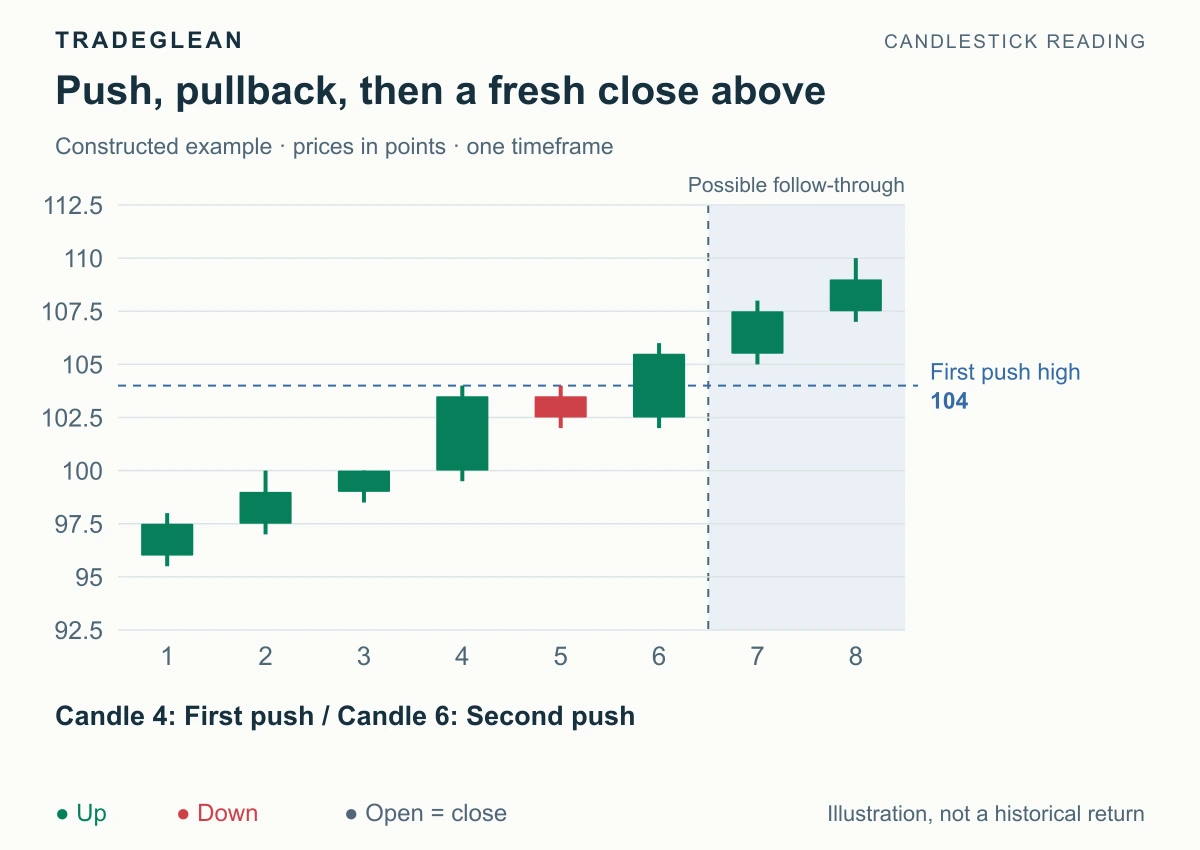
Constructed prices on one timeframe. Green candles close above their opens and red candles below. Candles 4–6 form the setup.
Candle 4 opens at 100 and closes at 103.5, with a high of 104 and a low of 99.5. Candle 5 pulls back from 103.5 to 102.5 while remaining above that first low. Candle 6 then opens at 102.5 and closes at 105.5, above 104.
The first push gains 3.5 points through its body. The pullback gives back 1 point. The last body gains 3 points and moves to a new closing position beyond the first high. Favor continued upward progress after candle 6 completes.
For application, mark 104 as the cleared level and the pullback low as a structure to monitor. A subsequent retest that holds the cleared area supports the bullish reading. The nearest prior resistance on the full chart is the first obstacle to evaluate.
Before candle 6 closes, the setup is still forming. That tells you when the directional signal becomes available, without requiring you to ignore the existing uptrend while you wait.
Apply the same logic to a bearish continuation
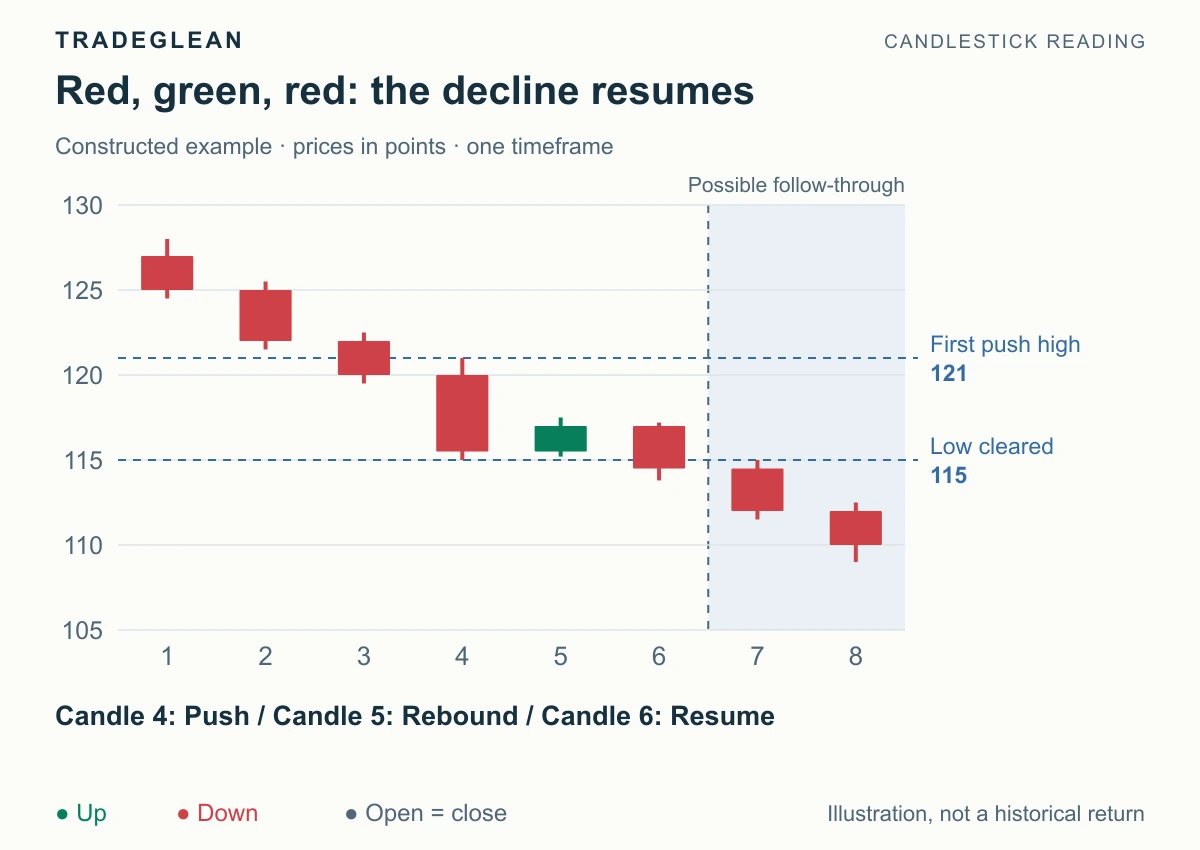
Candles 4–6 complete the bearish sequence; later candles illustrate continued decline.
Suppose the first red candle has a high of 121 and a low of 115. A smaller green candle rebounds but stays below 121. A third red candle then closes at 114.5, below 115.
The rebound has not overcome the first downward push, and the final close establishes fresh downside progress. The working view is bearish continuation. Watch for a rebound toward 115 to meet resistance, and use earlier support below the pattern as the next reference.
A countertrend green candle is therefore part of the bearish setup, not automatically a bullish reversal. Its role is defined by the first candle's boundary and the third candle's response.
Near-miss: a small body with a deep wick
Imagine the middle red candle in the bullish example opens at 103.5 and closes at 103.3. Its body is only 0.2 points, but its low reaches 98.
That low crosses the first candle's 99.5 boundary, so the sequence fails the containment rule. The tiny body does not make the pullback shallow. If the third candle also closes inside the first range, the resumption condition fails as well.
These checks let you reject a look-alike before seeing its eventual outcome. A valid pattern should satisfy the same measurements in every application.
Repeated sequences should make new progress
Green-red-green-red-green contains two overlapping three-candle groups. Use them as evidence of an ongoing rhythm when the push highs and pullback lows keep rising. For the bearish mirror, look for falling lows and lower rebound highs.
If every push stops at the same ceiling and every pullback returns to the same floor, read a range. Repeated colors have not produced new directional progress. The groups also share a candle, so do not count them as independent confirmations or convert their number into a success percentage.
Invalidation after a completed setup
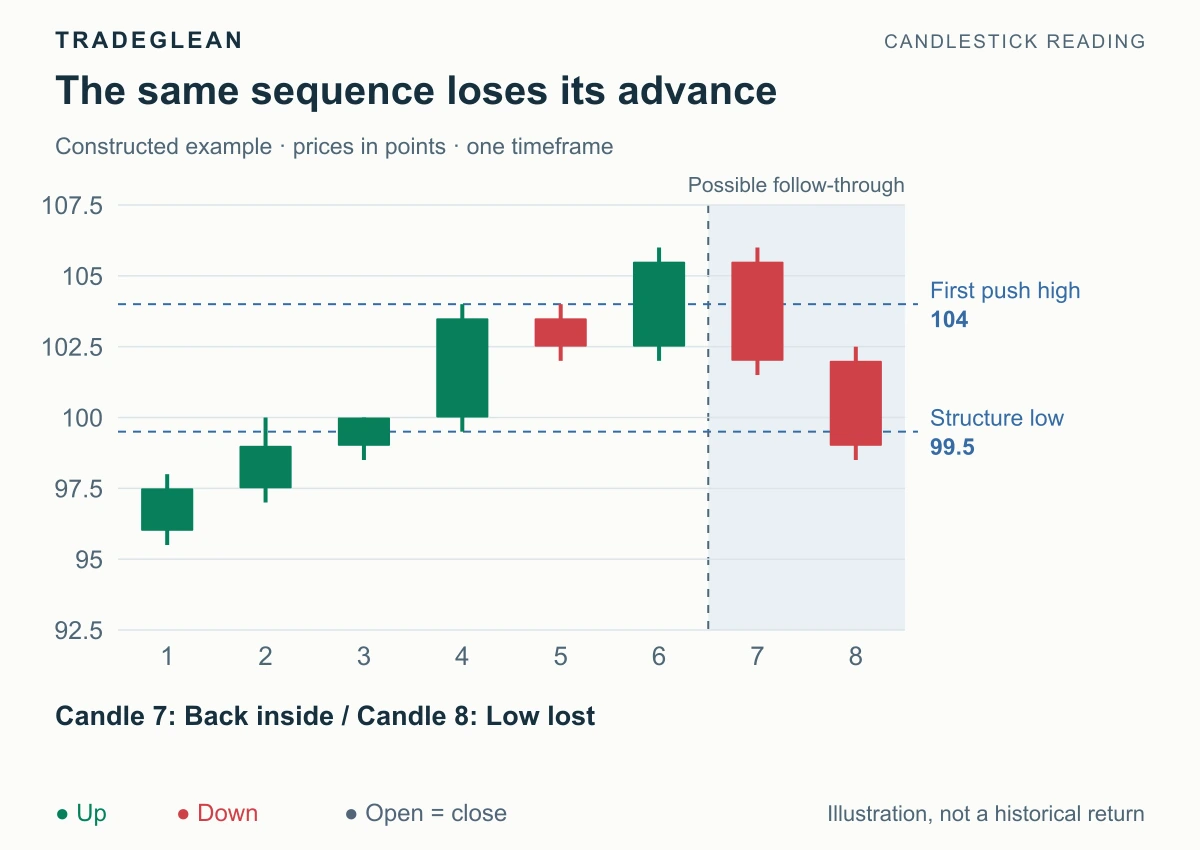
Candles 1–6 match the main example. Candle 7 closes back below 104, and candle 8 trades below 99.5.
A return below 104 is an early loss-of-follow-through warning. For the main bullish practice, use 99.5, the first push candle’s low, as the structural cancellation boundary. A break below it invalidates this full-structure continuation plan. For a bearish pattern, a reclaim of the broken low is a warning, while a break above the chosen rebound high invalidates the continuation plan.
Set entry and protection rules before acting. Buying the completion, waiting for an additional break, and buying a later retest create different risk distances. Use the actual entry and calculate space to the nearest obstacle.
Alternating colors do not complete the setup
A green-red-green sequence can meet the contained-pullback condition but fail the continuation condition. If the third candle closes below the first high, the exact bullish setup shown here is unfinished. A later advance might form a different setup; it does not retroactively change the original three candles.
Compare three candles with traditional three methods
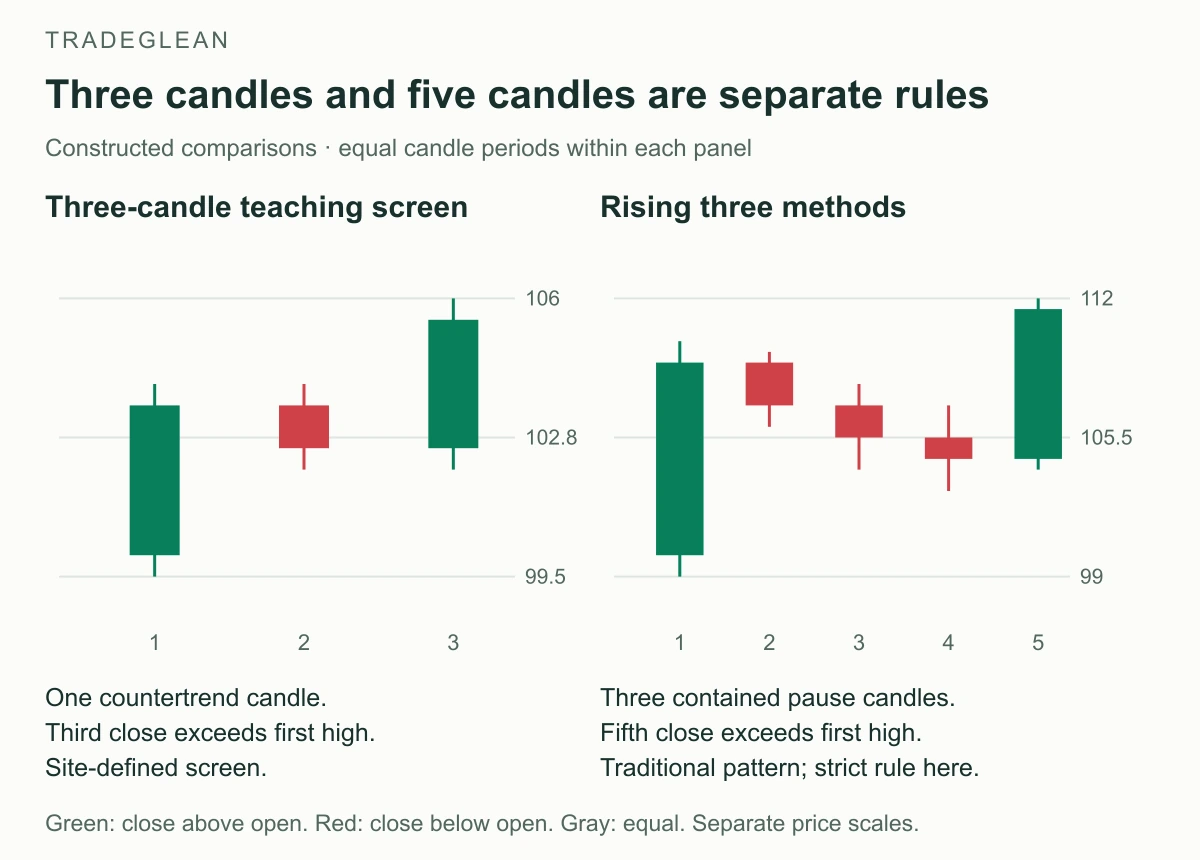
| Test | This three-candle screen | Traditional three methods used in the linked guide |
|---|---|---|
| Full pattern count | Three candles | Five candles |
| Countertrend pause | One candle | Three smaller candles |
| Main bullish closing test | Third close above first high | Fifth close above first high |
| Identity | Site-defined practice rule | Traditional pattern, with the guide's stated strict closing rule |
A normal trend pullback need not fit either exact count. Use Simple Pullbacks when the broader pause matters more than a candle label.
Reference
StockCharts: Support and Resistance covers the price boundaries used in this analysis. The alternating-candle setup and its strict closing trigger are the stated analytical framework for this article.
Check your understanding
A strong first green candle is followed by a red pullback and a third green candle. The third closes inside the first candle’s range. Is the bullish three-candle continuation complete?
Show the explanation
No. Under this site’s teaching rule, the third close must exceed the first high. Three alternating candle colors alone do not complete it. This three-candle construction is separate from the traditional five-candle rising three methods.