Breakout Candles: Identify Bullish and Bearish Breaks
Learn what a breakout candle is, compare bullish and bearish closing breaks, spot wick-only attempts, and separate confirmation from an entry fill.
In brief
- Direction
- Close above a range: bullish breakout. Close below: bearish breakout.
- Role / context
- Call it continuation only when the preceding trend points the same way.
- Main trigger
- Main example: a completed close above the previously marked 103 ceiling.
- Cancel when
- A close back inside 99–103 cancels an unfilled plan; a filled trade follows its preset exit.
- Next decision
- At the illustrated 107.8 close, resistance at 110 leaves only 0.30R under the stated stop.
Before you read · terms and starting articles
New to a term? Open the trading glossary.
Candlestick Reading for Beginners
Browse the articles
Begin with anatomy and context
Single-candle signals
- Doji and Spinning Tops: Read the Pause, Then the BreakBeginner · 5 min read
- Dragonfly and Gravestone Doji: Bullish vs. Bearish SignalsBeginner · 5 min read
- Hammer vs. Hanging Man: Identify the Shape and DirectionBeginner · 5 min read
- Shooting Star vs. Inverted Hammer: Which Way to Read It?Beginner · 5 min read
Reversal combinations
Momentum and continuation
Connect the signal to risk
In this article
What is a breakout candle?
A breakout candle moves price beyond a previously identified support, resistance, or consolidation boundary. This guide uses a closing rule: a completed close above the range ceiling is a bullish breakout; a completed close below the floor is a bearish breakout. A wick through the boundary shows an intraperiod attempt, but does not satisfy this closing rule.
A large body closing near its high or low can make the break more convincing. The boundary and the close establish the breakout direction; size and shape help judge its strength.
This article judges the breakout candle itself: the boundary, closing location, and follow-through. For the preceding pressure near a range edge, use Range-Break Squeezes. For a small box still inside a larger range, use Inside Range Breaks.
Call the breakout trend continuation only when an established preceding trend points the same way. A range alone does not establish that prior trend. The practical job is to identify a real boundary, check the completed close, then decide how to enter or manage the move. Holding outside the range supports continuation; returning inside is the first failure warning.
How to identify a breakout candle
This setup consists of a prior consolidation plus one completed breakout candle. There is no fixed candle count for the range, but its edges should be visible from repeated reactions and overlapping prices before the breakout.
| Check | Bullish breakout | Bearish breakout |
|---|---|---|
| Range boundary | Previously identified ceiling | Previously identified floor |
| Typical strong body | Green, with upward progress from open to close | Red, with downward progress from open to close |
| Body | Substantial compared with nearby range candles | Substantial compared with nearby range candles |
| Close | Above the range high, preferably near its own high | Below the range low, preferably near its own low |
| Main scenario | Advance outside the range | Decline outside the range |
Candle color is secondary to location. For example, a red candle opening at 104 and closing at 103.6 still finishes above a 103 ceiling. It has lost ground during its own period, so it is less forceful than the green example, but it has not closed back inside the range.
A wick crossing the boundary while the close remains inside is a rejection or attempted breakout under this method. A large candle that stays within the old range also fails the closing rule. Other methods can trade an intraperiod price break; those use a different trigger.
See the bullish break complete
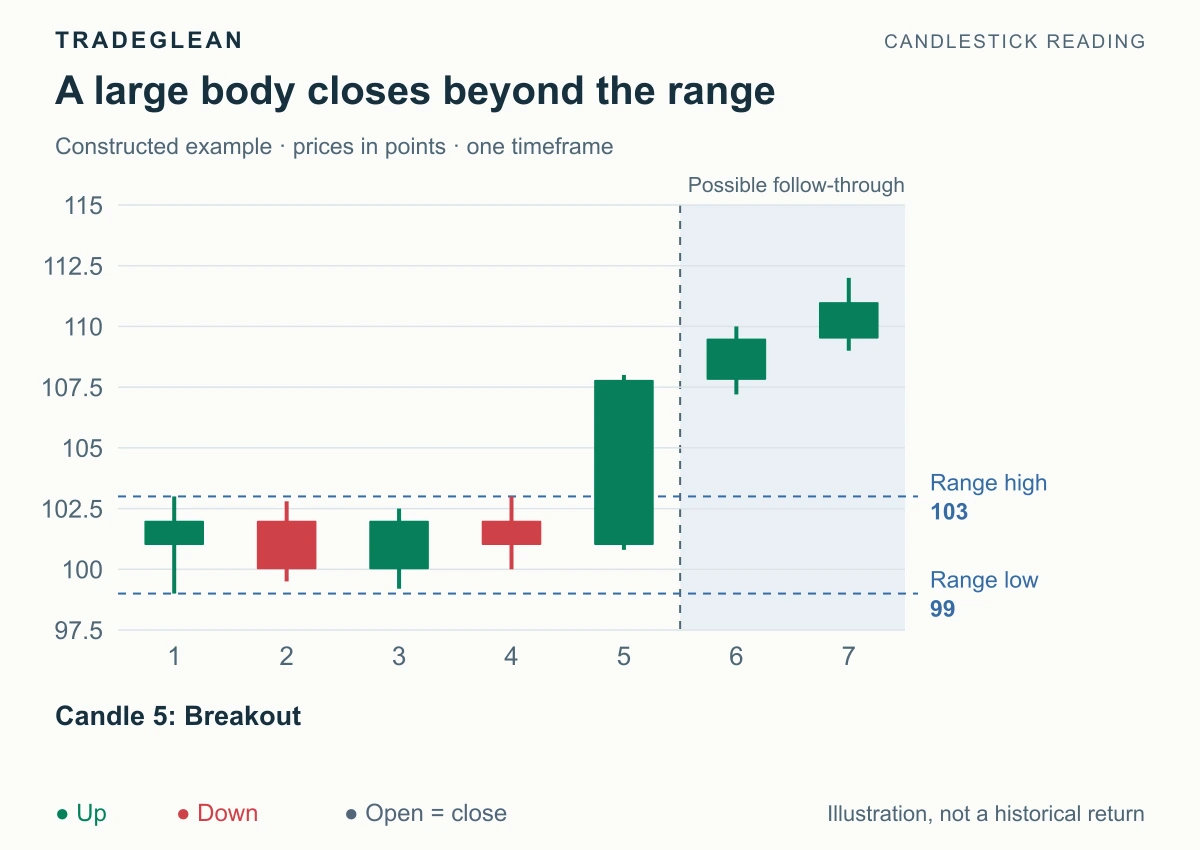
Constructed prices. Candles 1–4 form a 99–103 range; candle 5 completes the breakout. Green closes above open and red closes below.
Candle 5 has an open of 101, a high of 108, a low of 100.8, and a close of 107.8. The chart does not show the order in which its high and low occurred. Its body is 6.8 points within a full range of 7.2, about 94.44%. That percentage describes this example, not a universal cutoff.
The decisive comparison is 107.8 > 103. The close has cleared the earlier ceiling and retained most of the candle's upward move. Favor an upward extension while the breakout holds.
The former ceiling at 103 becomes the first area to monitor on a pullback. A retest that holds around that area supports the idea that price is establishing itself above the range. The next two candles in the figure illustrate upward follow-through; they were not known at candle 5's close.
Read a bearish break with the same checklist
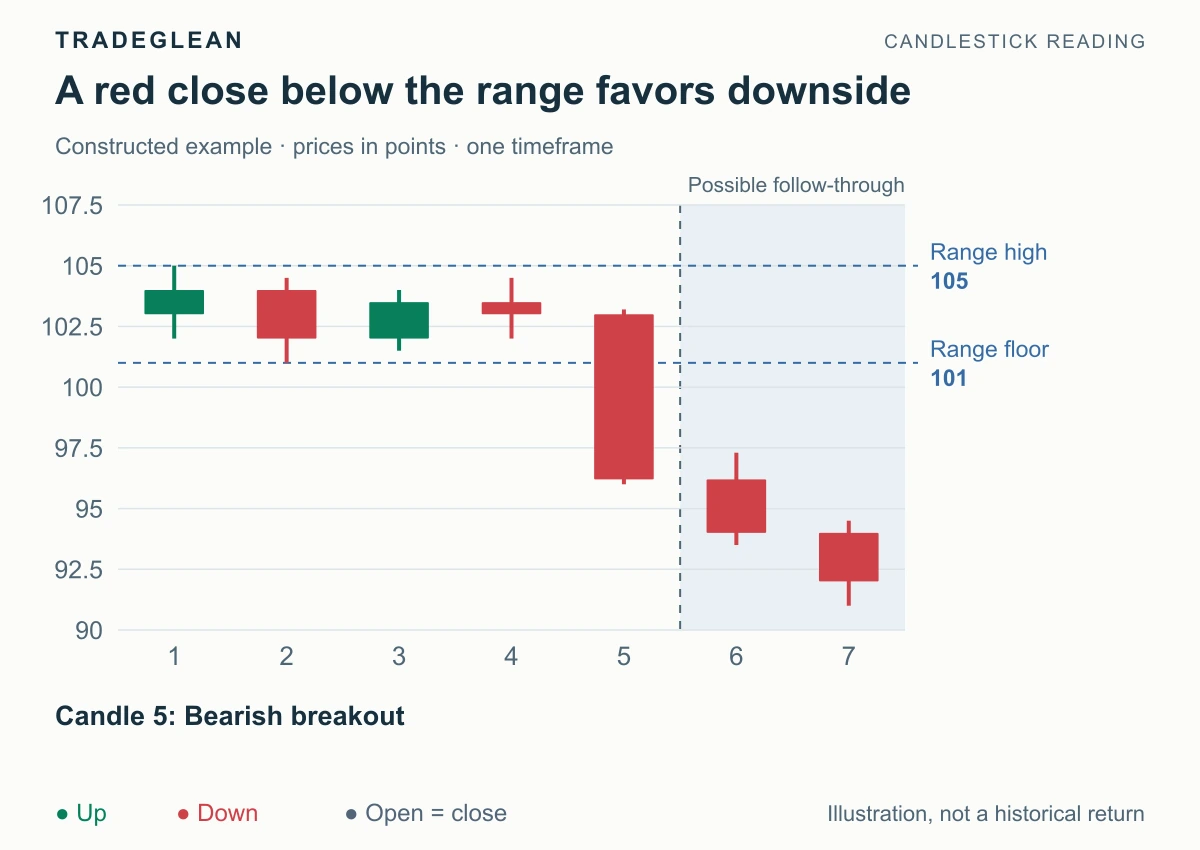
Candle 5 closes at 96.2 below the 101–105 consolidation.
Suppose price consolidates between 101 and 105, then a red candle opens at 103 and closes at 96.2 near its low. That is a closing break below the 101 floor.
The working view is bearish. Watch whether a rebound toward 101 meets resistance and whether new closes continue lower. Previously identified support beneath 96.2 is the first obstacle to assess.
An isolated red candle in the middle of the range would not give the same signal. Its position relative to the old floor is what makes the direction actionable.
Choose a breakout entry or a retest entry
A breakout-entry method evaluates execution after the close outside the range. It joins the move promptly, but a large candle can leave a wide stop distance. A retest-entry method waits for price to return toward the broken boundary and form a new rejection or continuation signal there.
An ordinary buy stop at 103 can trigger while the candle is still forming, including during a wick-only attempt. It does not wait for a closing breakout. If your rule needs a completed close, evaluate that close first and then use the available quote for execution. The stop order vs. limit order guide explains why a trigger, a limit price, and a fill are separate events.
For the bullish example, a retest is a new observation around the former 103 ceiling. It is not a claim that an order at 103 must fill. If price rises without returning, that entry does not occur.
Measure the space using the entry available to your method. For an arithmetic example, assume entry at 107.8 with a protective reference at 100.5: the price risk is 7.3 points. If independently marked resistance is 110, the remaining 2.2 points give only 0.30R before costs. That resistance is an assumed additional obstacle, not information supplied by the later candles in the illustration. Actual fills and any stop buffer change the calculation. Keep the bullish breakout view, but do not confuse it with an attractive entry at that price.
Near-miss and failure: know the difference
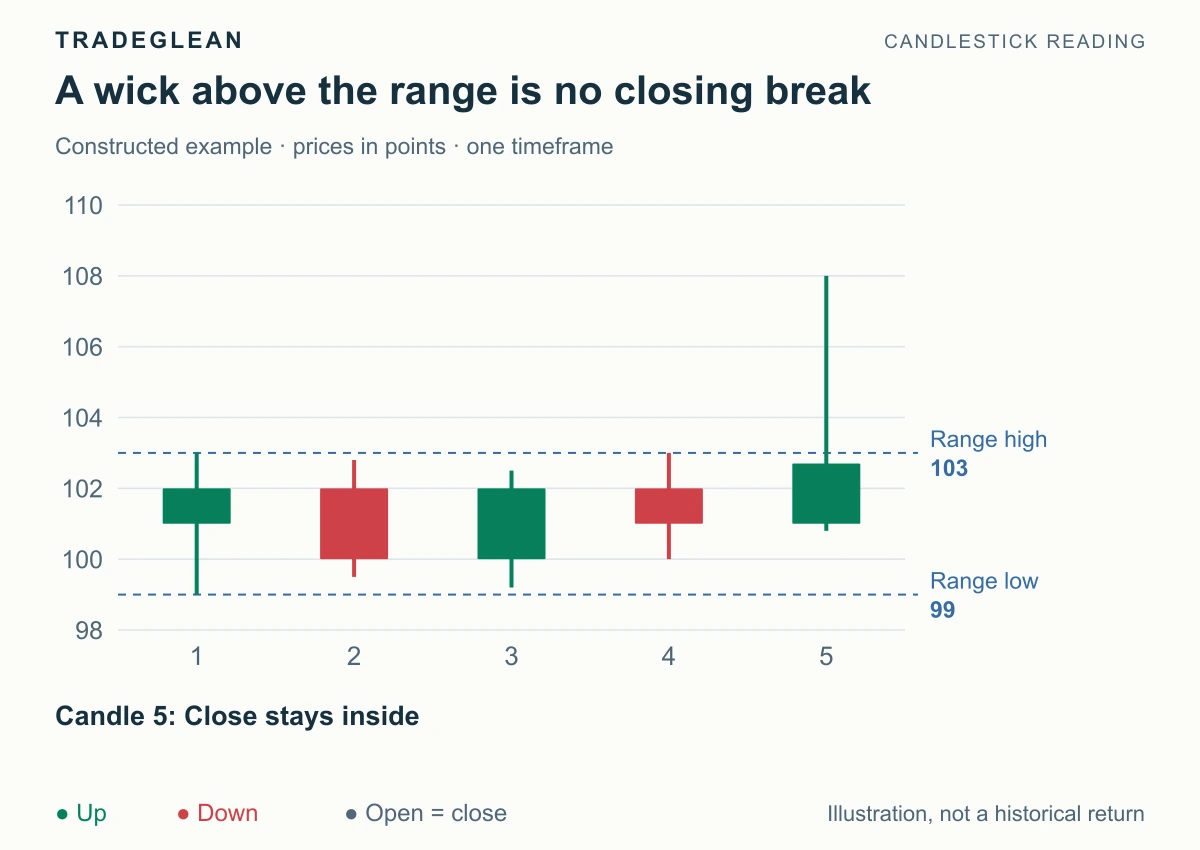
The same four range candles precede an upward attempt. Candle 5 reaches 108, but closes inside at 102.7.
Compare this with the first figure: both fifth candles have a high of 108, but their closes differ. 102.7 < 103, so this candle never completes the closing-breakout rule. Its long upper wick shows that the period did not retain the move above the ceiling. It is a near-miss at recognition time; its high alone cannot establish the required closing break.
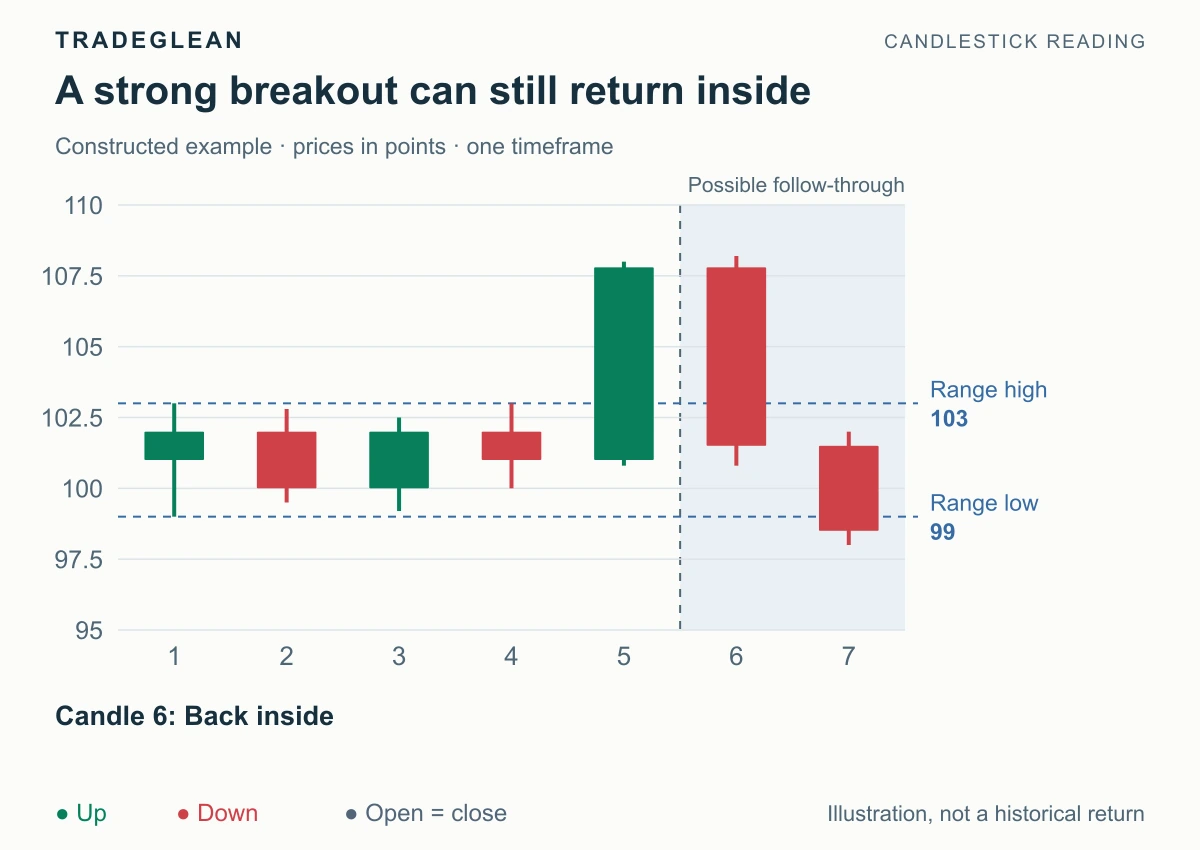
This sequence first completes the breakout at candle 5, then loses it at candle 6.
Here, candle 6 closes at 101.5, inside the original 99–103 range. That is a failure of the breakout to hold, so cancel an unfilled bullish breakout plan under the rule used here. A filled position follows its protective orders and prewritten exit conditions.
A full break below the opposite range edge would add stronger evidence against the bullish structure. A failed upward breakout does not automatically supply a short entry; identify the new bearish trigger before changing sides.
Optional detail: use retracement prices as measurements
If studying a pullback into the breakout body from 101 to 107.8, its length is 6.8 points. Measured down from the close:
| Body retracement | Price |
|---|---|
| 38.2% | About 105.20 |
| 50% | 104.40 |
| 61.8% | About 103.60 |
These are reference prices, not established support simply because a fraction produces them. Give priority to actual structure and the response around the old range boundary. If you measure the full low-to-high range instead, recalculate from those different anchors.
Read confirmation one completed candle at a time
| Observation point | What is established | What remains unknown |
|---|---|---|
| After candle 4 | The illustrated range spans 99–103 | Whether the next candle will break either edge |
| Candle 5 reaches 108 while forming | Price has traded above 103 | Its final close and whether this closing rule will pass |
| Candle 5 closes at 107.8 | The bullish closing breakout is complete | Whether a retest will occur or the next candle will hold outside |
| Candle 6 closes at 101.5 in the failure figure | The completed break has returned inside | Whether a separate bearish setup will develop |
Mark the boundary before the attempt. Wait for the observation required by your method. Then assess the available entry, the first obstacle, and the protective reference together. The shaded later candles illustrate possible outcomes; they cannot be used to approve an earlier entry.
Sources and terminology
Brooks' glossary uses breakout broadly for price extending beyond a significant prior level. This article applies the narrower completed-close rule stated above.
StockCharts: Support and Resistance explains range boundaries and their changing role after a break. Continue with turning a signal into a trade to connect the breakout with its trigger, failure reference, and risk.
Check your understanding
A range breaks upward, but the chart provides no earlier trend. Should the first description be “bullish continuation”?
Show the explanation
Call it an upward breakout. Continuation requires an established earlier uptrend. If the earlier trend was downward, further structure is needed to assess a reversal. Do not infer the missing background from the breakout candle.