Candlestick Reading for Beginners
Learn candle anatomy, reversal and continuation patterns, then connect the signal to entry conditions, invalidation, and position risk.
View the collectionFree day trading education
Understand how day trading works, read charts, and connect an entry to an exit and a risk limit. Start with clear, illustrated examples.
Free to read. Examples focus on gold, forex, and crypto.
Day trading means opening and fully closing a position within the same trading day, with no overnight holding. You may stay in a trade for minutes or hours, but you exit before that trading day ends.
For example, you buy at 10:00 a.m. and sell the entire position at 2:00 p.m. on the same trading day, before the session closes. That is a day trade whether it wins or loses. If you keep the position overnight and sell it the next trading day, it is not a day trade.
Understand how a trade works →Start with positions, orders, and what a trade actually costs.
Read the four prices in a candle, then find areas where price has turned.
Calculate the possible loss, compare the target, and understand exit choices.
Distinguish a trend from a range before choosing a trading technique.
Connect the setup with a trigger and a clear point where the idea fails.
Make a decision before seeing the next candle, then review the process.
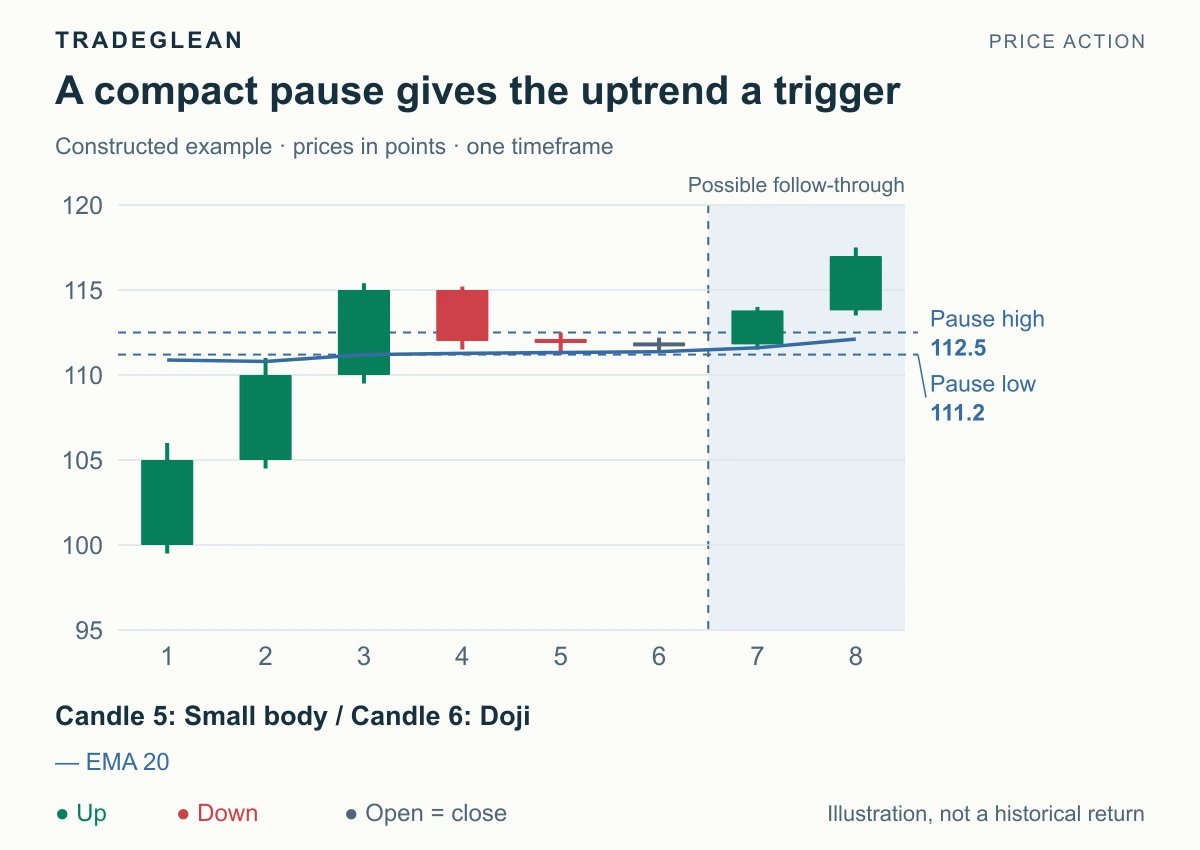
See how market context, an entry condition, and a failure point fit together.
If the setup fails: a break below the pause low before confirmation cancels this recovery setup. After entry, follow the planned stop; do not move it farther away to keep the idea alive.
Read the full methodLearn candle anatomy, reversal and continuation patterns, then connect the signal to entry conditions, invalidation, and position risk.
View the collectionRead the structure beyond individual candles: pullbacks, channels, range breaks, and trend reversals, with visual identification rules and practical price examples.
View the collectionIndependent day trading education with illustrated examples, stated rules, and sources you can follow. Each worked example separates what was known at the signal from the later result.
Day trading involves opening and fully closing positions within the same trading day, without holding them overnight. A trade may last minutes or hours; it must be closed before that trading day ends. Start with the trading basics for positions, orders, and costs.
Begin with how a trade works, including costs and risk. Then learn how analysis describes market conditions and how a strategy turns those conditions into specific rules. The beginner guide connects these subjects to the relevant articles.
Yes. All currently published articles, guides, and collections are free to read. No account or email signup is required. Browse the article library by subject or use the search above.
There is no single amount that applies to every reader or product. Minimum order size, contract value, margin rules, trading costs, and personal circumstances all matter. A provider's minimum deposit is not a measure of affordability. Learn how position size and stop distance affect risk before interpreting any account minimum.
Read a historical chart one candle at a time. Write down your direction, trigger, cancellation point, and costs before revealing the next candle. Start with the chart practice, then use a simulator and keep a journal. Simulated fills can differ from real execution; practice results do not establish future profitability.
No. Understanding a method does not establish an edge or guarantee a result. Market conditions change, costs affect outcomes, and leverage can magnify losses. Our examples explain rules and their limitations. Read the risk disclosure for more context.
No. TradeGlean explains general trading methods through articles and illustrated examples. It does not provide live entry alerts, personalized recommendations, or account management.