Rising and Falling Three Methods: Spot Trend Continuation
Identify the five candles of rising and falling three methods, check the pullback boundaries, and use the final close to read bullish or bearish continuation.
In brief
- Direction
- Rising three methods: bullish continuation. Falling three methods: bearish continuation.
- Role / context
- A contained pause within an established trend.
- Main trigger
- Final candle closes above the first high (110), or below the first low (110) in the bearish example.
- Cancel when
- Bullish structure: below 99. Bearish structure: above 121.
- Next decision
- The main practice uses the full pattern boundary, not a tighter middle-candle stop.
- Rule type
- Traditional pattern; this example uses the stricter final close beyond the first candle’s full range.
Before you read · terms and starting articles
New to a term? Open the trading glossary.
Candlestick Reading for Beginners
Browse the articles
Begin with anatomy and context
Single-candle signals
- Doji and Spinning Tops: Read the Pause, Then the BreakBeginner · 5 min read
- Dragonfly and Gravestone Doji: Bullish vs. Bearish SignalsBeginner · 5 min read
- Hammer vs. Hanging Man: Identify the Shape and DirectionBeginner · 5 min read
- Shooting Star vs. Inverted Hammer: Which Way to Read It?Beginner · 5 min read
Reversal combinations
Momentum and continuation
Connect the signal to risk
In this article
Rising three methods favors an advance; falling three methods favors a decline
Rising three methods is a bullish continuation pattern. Falling three methods is bearish continuation. Each shows a strong move, a contained pause, and a final push that resumes the original direction.
The small countertrend candles are part of the setup. They show a pullback that has not broken the first strong candle's range. Once the final candle closes in the trend's direction, the main scenario is continuation rather than reversal.
How to identify the five-candle pattern
The standard example uses five consecutive completed candles.
| Part | Rising three methods | Falling three methods |
|---|---|---|
| Background | Existing upward move | Existing downward move |
| Candle 1 | Large green body | Large red body |
| Candles 2–4 | Three smaller pullback candles inside candle 1's full range | Three smaller rebound candles inside candle 1's full range |
| Candle 5 | Large green candle resumes the rise | Large red candle resumes the decline |
| Closing rule used here | Beyond candle 1's high | Beneath candle 1's low |
The final high/low closing rule is deliberately stricter than definitions that only require a new close beyond the first close. The small middle candles commonly lean against the trend; their containment is the essential check in these examples.
Use the first candle's high and low, including wicks, as the boundaries. Its body edges are not the full containment range. Green means close above open and red means below throughout these constructed charts.
Recognize a bullish rising-three-methods sequence
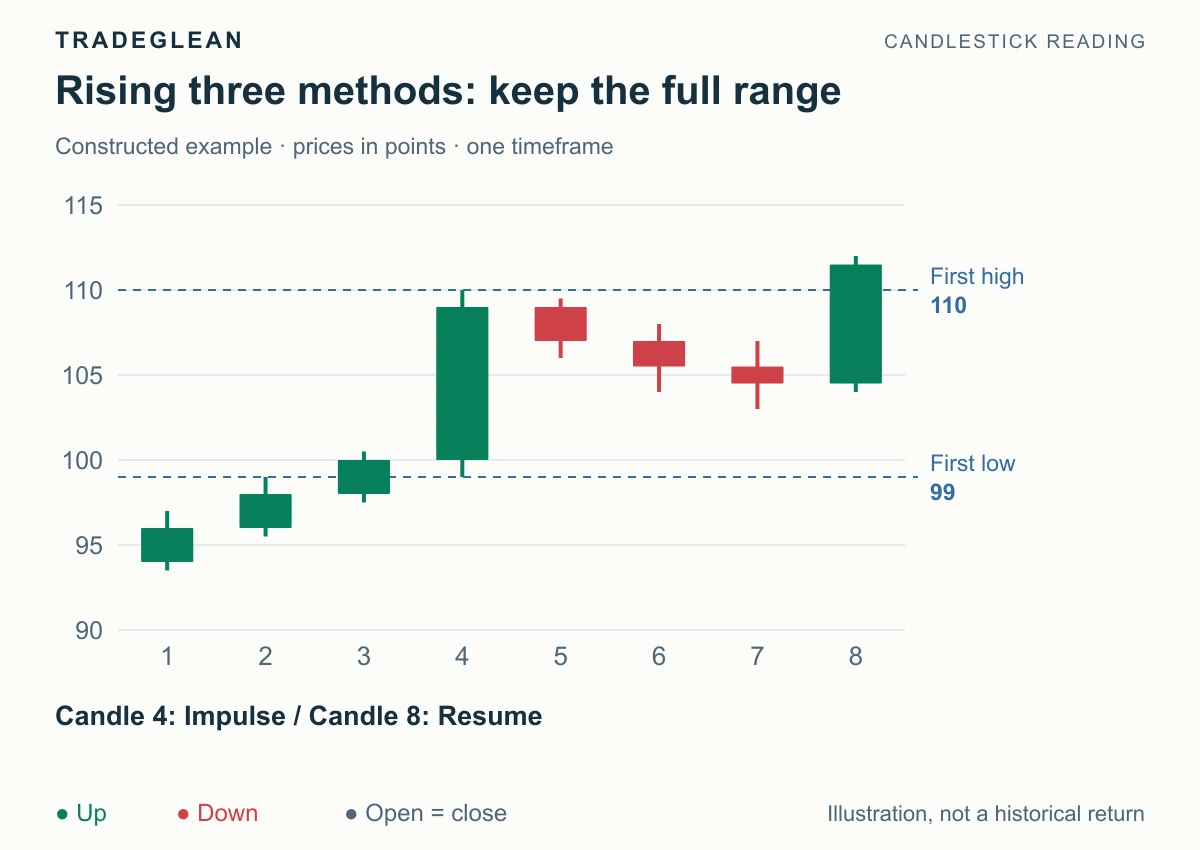
Candles 4–8 form the five-candle pattern. The two horizontal lines mark the first candle's full range.
Candle 4 has an open of 100, a high of 110, a low of 99, and a close of 109. The order of the intraperiod extremes is not specified. Its containment range is therefore 99–110.
The three smaller candles have ranges of 106–109.5, 104–108, and 103–107. All are inside the first candle. Their closes drift lower, but the pullback remains contained.
Candle 8 closes at 111.5, above 110. The final push completes the pattern. Favor bullish continuation, with the cleared 110 boundary and the pullback structure providing the next places to monitor.
This is useful during a healthy upward move: the decline in the middle is a controlled pause, and the last close demonstrates that buyers have resumed progress. Check the larger chart for resistance ahead before turning the signal into a new entry.
Recognize the bearish version
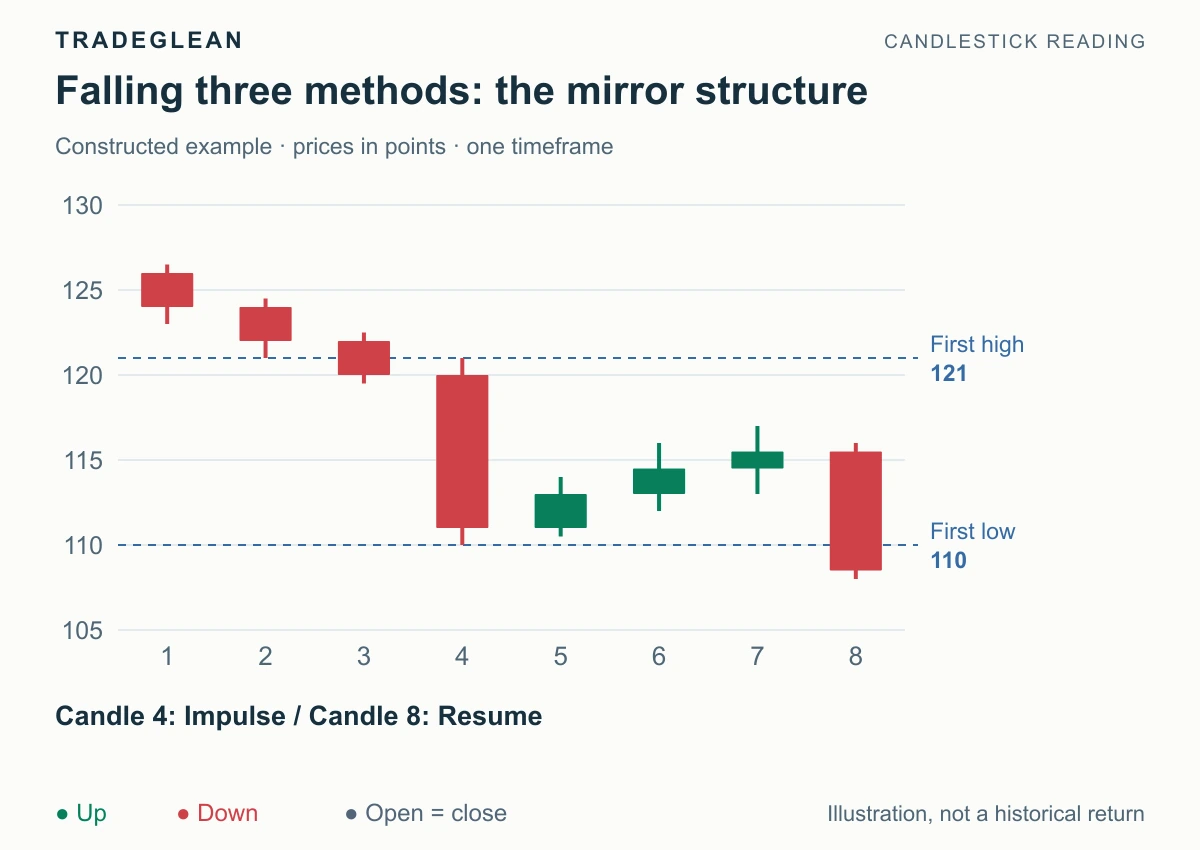
The first strong red candle spans 110–121. Candle 8 closes at 108.5.
The rebound highs are 114, 116, and 117, all below the first high at 121; their lows stay above 110. The final red candle closes at 108.5, beneath the first low.
The working view is bearish continuation. The rebound failed to overcome the preceding decline, and sellers have pushed the close to a new low. Watch whether a later rally meets resistance near the cleared 110 area. Earlier support below the setup gives the next objective to assess.
Before the last candle completes, you can describe a developing bearish continuation setup. You cannot claim that the final downward trigger has already occurred.
Near-miss: a middle wick crosses the boundary
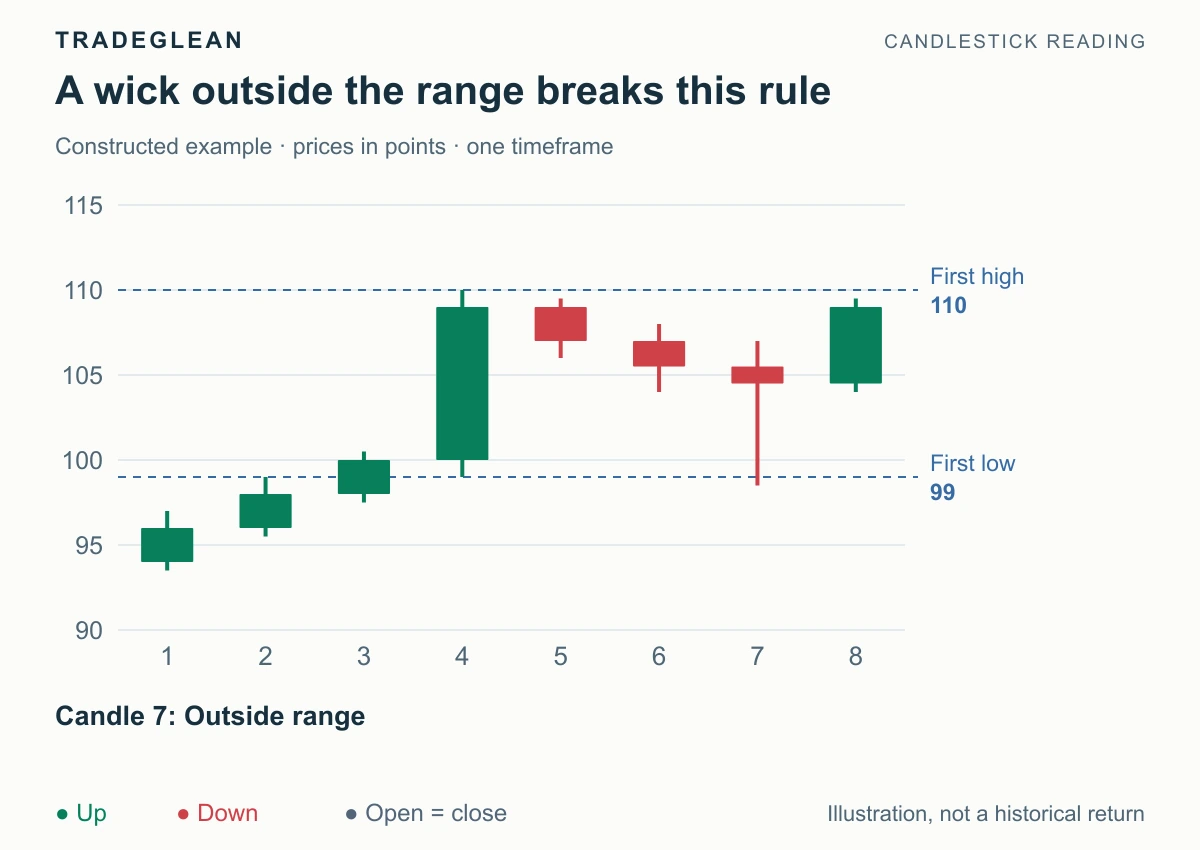
One changed low is enough to fail the stated containment condition.
Even if all three middle candles close above 99, a wick reaching 98.5 breaks the rule. Check the whole range, not just the bodies. A later green close above 110 may show a new advance, but it does not restore the earlier five-candle definition.
The opposite applies to falling three methods: a rebound wick above the first red candle's high breaks containment. A pause with more than three middle candles is a separately labeled variation. Longer stretches are often easier to read as consolidation ranges.
Turn the continuation view into a plan
The main practice evaluates an entry after the final close above 110 and uses the full pattern low at 99 for structural cancellation. The numerical protective trigger below is 98.8, a stated buffer. A retest entry is an alternative: it requires a new observed signal and may never occur. It is not the method used for the following arithmetic.
A protective reference below the whole pattern low gives the original continuation idea room to work. A tighter reference based on the smaller pullback low is a different plan and should be justified explicitly. Calculate quantity from the chosen stop distance rather than choosing the stop to fit a desired quantity.
For example, entry 111.6 and a reference at 98.8 create 12.8 points of risk. With prior resistance at 120, the space is 8.4 points, about 0.66R. That leaves the bullish view intact but makes this entry unsuitable for a method requiring more space. A new pullback structure may provide another opportunity.
What invalidates continuation
After completion, a close back through the cleared boundary is a warning that follow-through is weakening. A break of the structure's protective low cancels a bullish plan built on that support holding. Reverse the conditions for a bearish plan.
The pattern's usefulness comes from a defined direction and a defined boundary. You can identify the expected move before it happens and recognize when the market stops behaving as the setup requires.
The middle candles must respect the chosen boundary
With a first-candle range of 99–110, all three middle candles must remain inside that entire range under the rule used here. A final green close at 111.5 completes the bullish version. If a middle wick drops below 99, the strict five-candle pattern is absent even when its body remains inside. The market may still trend upward; it simply does not meet this definition.
Distinguish the five-candle pattern from a short screen
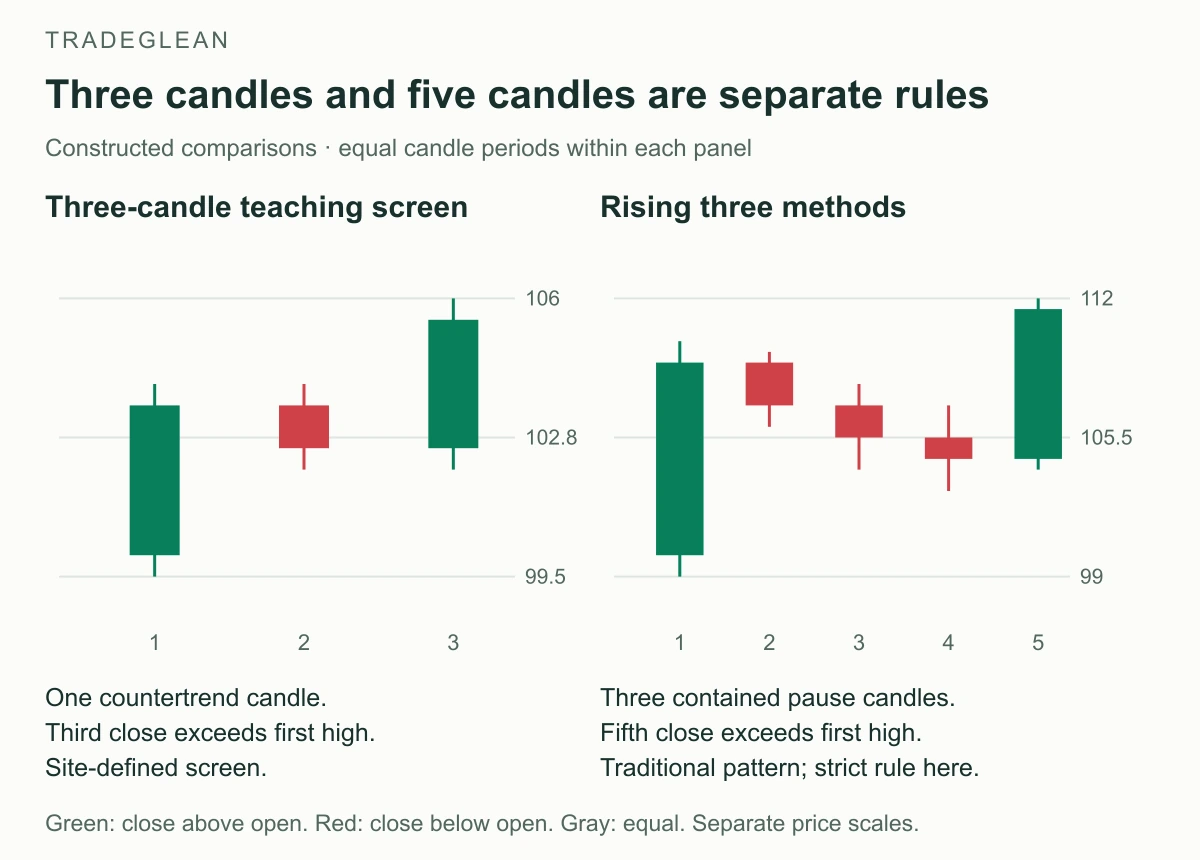
The right-hand pattern is the five-candle lesson here: one impulse, three contained middle candles, then a resumed close. The left is the separate three-candle teaching screen. A final close beyond the first full high or low is this guide's strict convention; do not quietly replace it with a body-only test.
Reference
StockCharts' Pattern Dictionary describes rising and falling three methods. The stricter final-close rule and numerical plans are stated for these examples.
Check your understanding
In rising three methods, the pause remains inside the first candle. The last green candle closes above the first body but below the first high. Does it meet this article’s strict continuation rule?
Show the explanation
No. This guide chooses a final close beyond the first candle’s full high for its main rising example. A body-only break is a looser definition and must be labeled separately.