Dragonfly and Gravestone Doji: Bullish vs. Bearish Signals
Recognize dragonfly and gravestone doji from their wicks and closing prices, then apply their bullish and bearish readings at support and resistance.
In brief
- Direction
- Dragonfly at support: bullish recovery. Gravestone at resistance: bearish rejection.
- Role / context
- Local reversal setups after a decline or rally, respectively.
- Main trigger
- Dragonfly example: close above 106. Gravestone: close below 114.
- Cancel when
- Dragonfly: below 99. Gravestone: above 121.
- Next decision
- Without the stated location, do not copy the example’s directional conclusion.
Before you read · terms and starting articles
New to a term? Open the trading glossary.
Candlestick Reading for Beginners
Browse the articles
Begin with anatomy and context
Single-candle signals
- Doji and Spinning Tops: Read the Pause, Then the BreakBeginner · 5 min read
- Dragonfly and Gravestone Doji: Bullish vs. Bearish SignalsBeginner · 5 min read · You are here
- Hammer vs. Hanging Man: Identify the Shape and DirectionBeginner · 5 min read
- Shooting Star vs. Inverted Hammer: Which Way to Read It?Beginner · 5 min read
Reversal combinations
Momentum and continuation
Connect the signal to risk
In this article
A dragonfly at support favors recovery; a gravestone at resistance favors a decline
A dragonfly doji after a decline into support is a bullish reversal setup. It records a move to lower prices followed by a close back at the top of the candle. A gravestone doji after a rise into resistance is a bearish reversal setup: the market reached higher prices but surrendered that advance by the close.
Name the scale of the change. A dragonfly at the end of a small downward pullback can support continuation of a larger uptrend; a gravestone after a small rally can restart a larger decline. The local rejection alone does not reverse every higher timeframe.
Use those as the primary directions to investigate. The next step is to check the shape, mark its extremes, and look for a break in the expected direction.
How to identify the two shapes
Each pattern consists of one completed candle with little or no body and one dominant wick.
| Identification check | Dragonfly doji | Gravestone doji |
|---|---|---|
| Visual shape | A T | An upside-down T |
| Open and close | At or very near the high | At or very near the low |
| Dominant wick | Long lower wick | Long upper wick |
| Opposite wick | Absent or very short | Absent or very short |
| Main reversal location | After a decline, preferably at support | After a rise, preferably at resistance |
A strict dragonfly has open = close = high. A strict gravestone has open = close = low. Real charts often show tiny differences; label those near-dragonfly or near-gravestone candles. This collection's near-doji identification tolerance is a body no larger than 10% of the whole range, with the opposite wick also no longer than 10% of the range for this identification checklist. The percentage is a working definition.
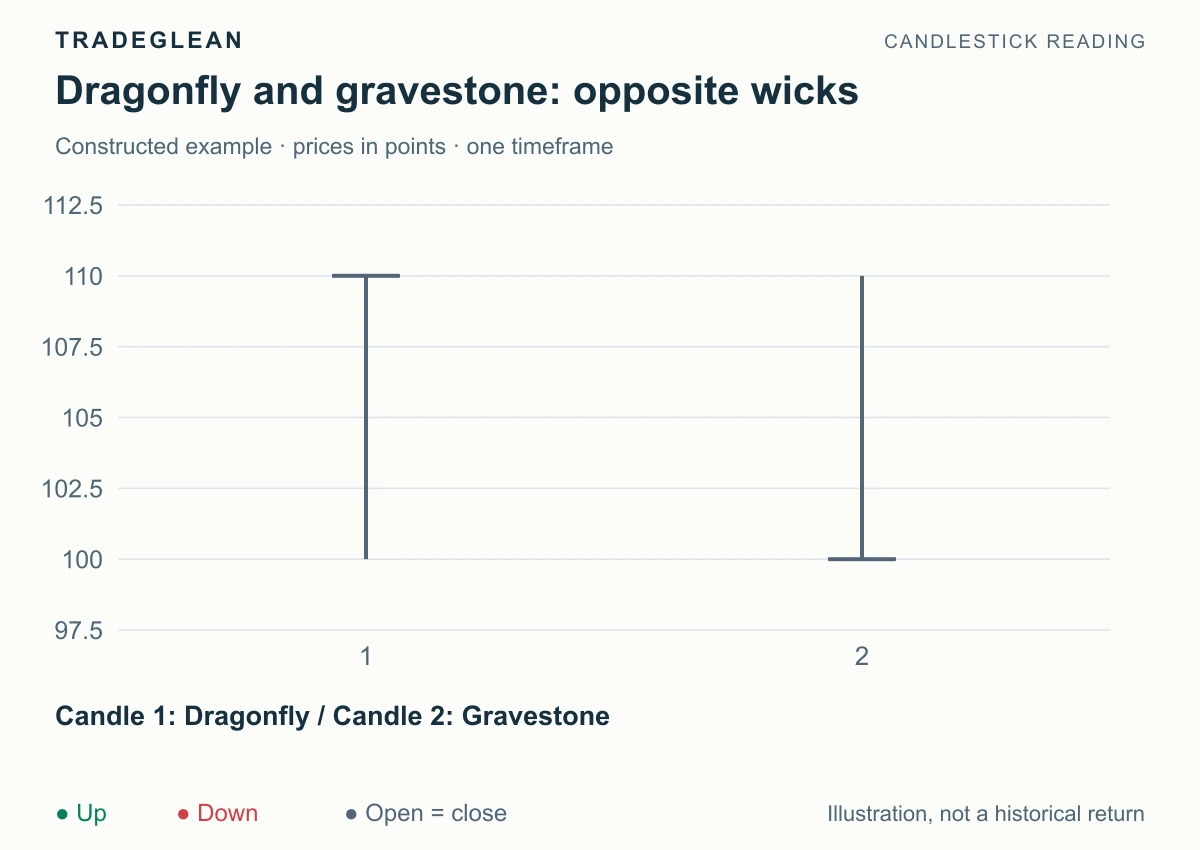
Constructed examples in price points. Gray means equal open and close; green means an up candle and red a down candle.
The dragonfly opens and closes at 110, also its high. Its low is 100. The gravestone opens and closes at 100, also its low, and reaches a high of 110. Both have a 10-point dominant wick and no body.
If the body is clearly visible, compare the candle with a hammer or hanging man, or an inverted hammer or shooting star. Two long wicks make a two-sided doji, not a clean T-shaped example.
Apply the bullish dragonfly reading
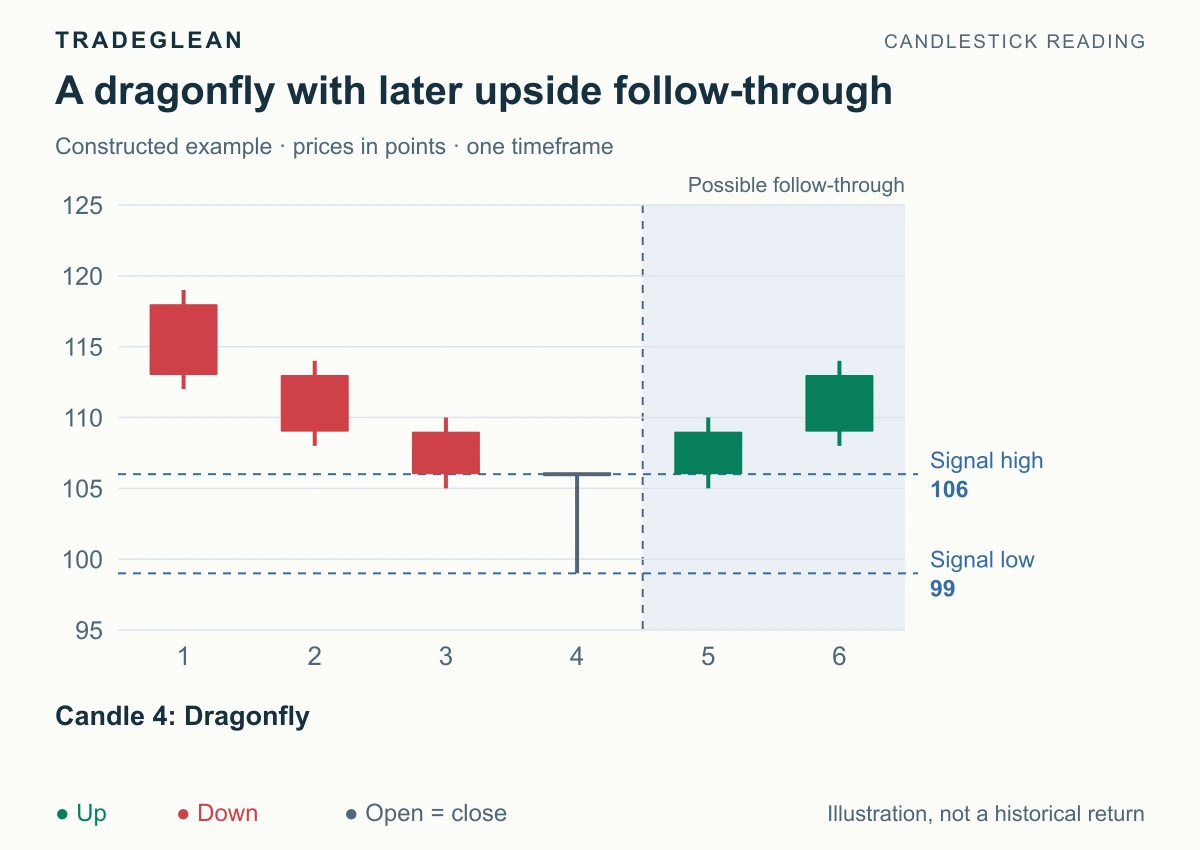
Candle 4 is the signal. Candles 5 and 6 illustrate later upside confirmation.
The decline reaches a low of 99 during candle 4, then finishes at 106. That recovery is the bullish feature: the market could trade lower but could not finish there.
At candle 4's close, the working view is bullish recovery, awaiting follow-through above 106. Candle 5 closes at 109, confirming that upward break under this article's closing rule. Candle 6 adds a higher close.
On a full chart, give priority to dragonflies that test support established before the signal. The figure shows a local low; it does not establish older support by itself. Mark the next prior high as the first area the recovery must tackle.
For the illustrated method, an entry condition might be a later close above 106, followed by execution under the chosen order rule. A protective reference below 99 follows the idea that the rejected low should hold. Use the actual entry price to calculate the distance to that reference.
Apply the bearish gravestone reading
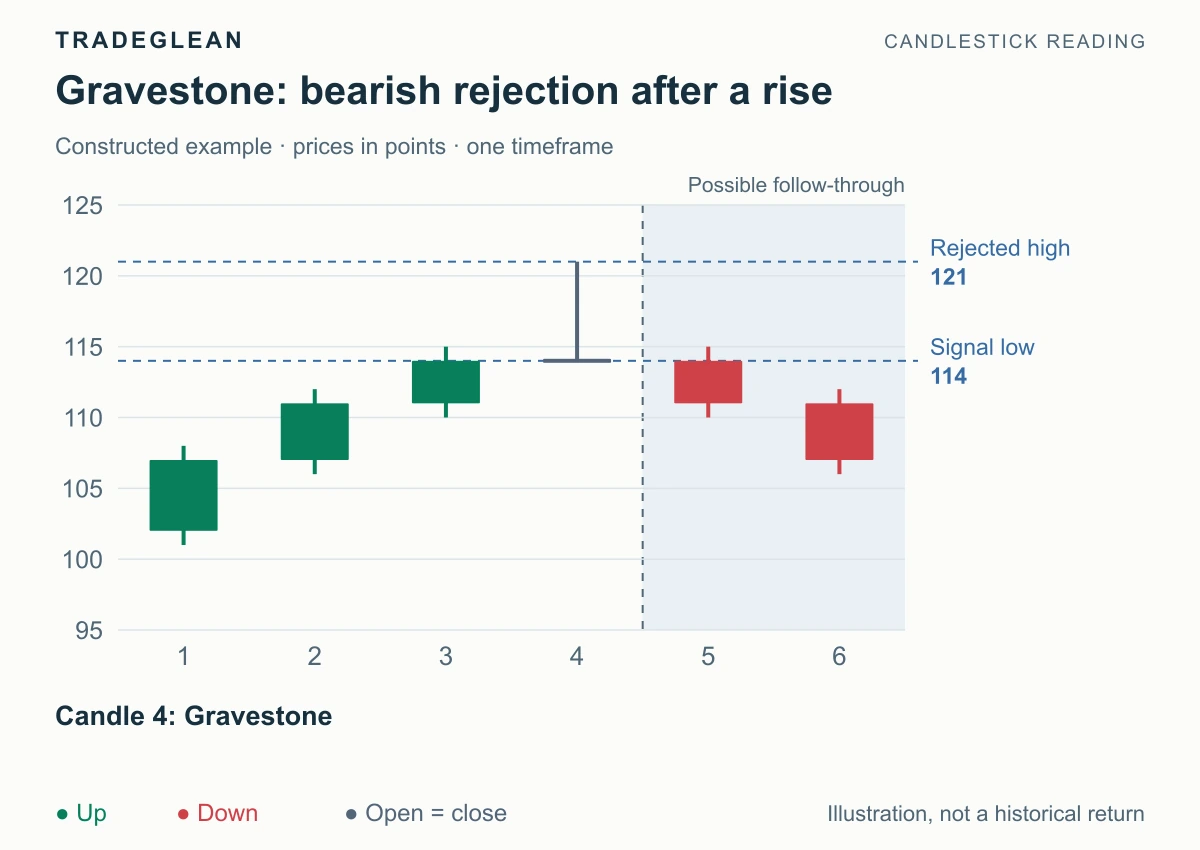
The gravestone is candle 4. Its high is 121 and its open, close, and low are 114. Later candles move lower.
This is the downward counterpart. Price has been advancing, but candle 4 gives back the entire move from 114 to 121. Favor a bearish pullback, especially when the upper wick tests previously marked resistance.
The closing trigger is below 114. Candle 5 closes at 111, supplying that confirmation. The next practical references are earlier support areas below the signal and the rejected high at 121 above it.
A gravestone that appears during a rebound within a downtrend can also support bearish continuation when it rejects resistance. Describe the local rally and the broader downtrend separately so the direction is clear.
Know when to drop the setup
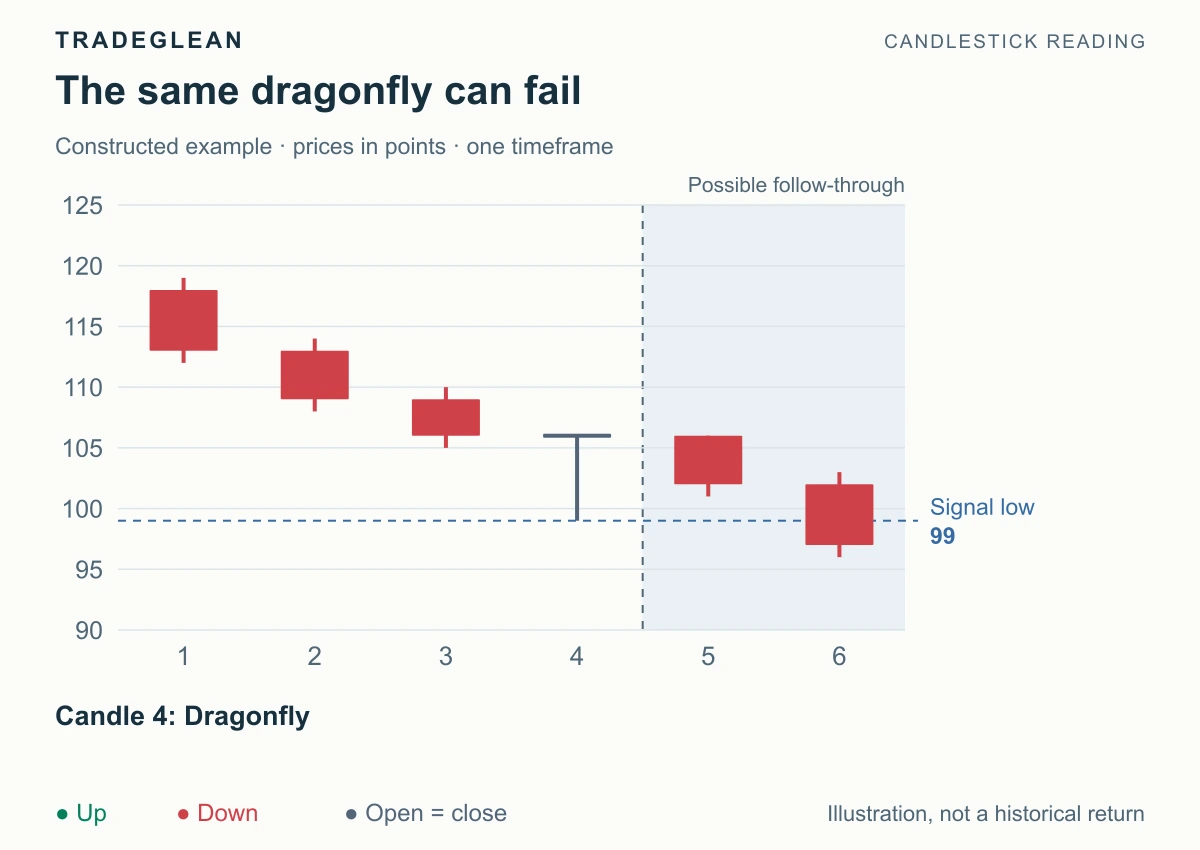
There is no break above 106. Candle 6 closes at 97, below the dragonfly low of 99.
For the bullish dragonfly, a break of the rejected low cancels the recovery setup. For the bearish gravestone, a recovery above the rejected high cancels the rejection setup. Use these boundaries to decide when the original reading no longer applies.
A long wick also creates a large potential stop distance. If the expected move runs straight into a nearby obstacle, keep the directional view but wait for a better-defined entry structure or leave the trade alone. The trading-plan guide shows how to calculate that space.
A nearly equal open and close needs context
An open of 100, close of 100.2, high of 110, and low of 99.9 create a near-gravestone: a small body near the low and a dominant upper wick. After a rally into resistance, this supports watching for a bearish trigger. A close below 99.9 meets the rule used here; a recovery above 110 contradicts the rejection. Away from a meaningful level, the same outline is less informative.
Reference
StockCharts: Dragonfly and Gravestone Doji describes the shapes. The numerical plans and follow-through charts here are constructed teaching examples.
Check your understanding
A dragonfly-shaped candle appears in the middle of a wide overlapping range. Can you apply the support-reversal example unchanged?
Show the explanation
No. The example requires a preceding decline into identified support, followed by upward confirmation. The same silhouette in the middle of a range lacks that location and does not supply the same directional case.