Stop Placement and Position Size: Calculate the Planned Loss
Choose a structural failure reference, translate its distance into money, and round quantity down without treating the stop as a loss guarantee.
Start with the premise that could fail
A stop reference should relate to the reason for the entry. For a long setup based on support holding, a meaningful move below that support challenges the premise. For a short based on resistance holding, the mirror applies above resistance.
Then calculate how much quantity fits the chosen money-risk budget. Choosing a large position first and squeezing the stop into ordinary price noise reverses those decisions. CME's position-size guide connects stop placement with the amount at risk.
Separate three prices
| Reference | Meaning |
|---|---|
| Structural invalidation | The price evidence that contradicts the setup |
| Protective trigger | The price or condition that activates an exit order |
| Actual fill | The price at which the exit executes |
These references can differ. A close-based interpretation can take longer than an intrabar protective trigger. The order type, available liquidity, and trigger basis determine execution; a drawn line does not guarantee the fill.
Calculate an illustrative long position
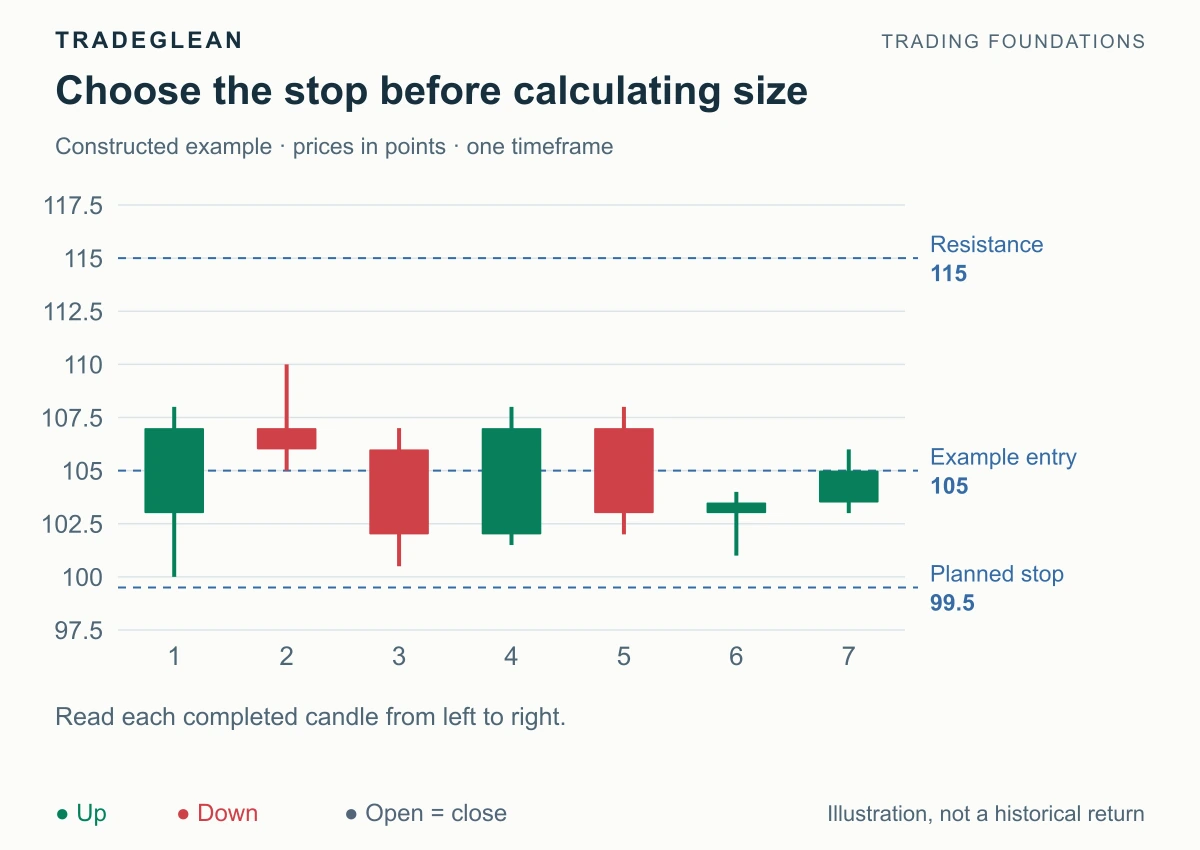
Constructed prices. The 0.5-point distance below support is an example allowance, not a recommended buffer for any market.
Assume the setup depends on 100 support holding, the planned entry is 105, and the protective trigger is 99.5. A separate resistance area begins at 115.
For this linear example, each unit earns or loses one currency unit per price point. Assume a money-risk budget of 120 and estimated round-trip costs of 0.50 per unit, including an execution allowance not already included in the prices.
Stop distance = 105 − 99.5 = 5.5 points.
Planned loss per unit = 5.5 × 1 + 0.50 = 6.00.
Quantity = floor(120 ÷ 6.00) = 20 whole units.
The planned total is 110 of price risk plus 10 of costs. A budget of 100 would permit only 16 whole units under the same assumptions: 16 × 6 = 96; 17 units would require 102.
The amounts 100 and 120 are arithmetic examples, not recommended account-risk limits. If no permitted order size fits a selected budget, this setup does not fit that budget.
Include the contract's value and quantity step
For a linear contract, the general calculation is:
Loss per unit ≈ stop distance × money value per price point + estimated costs per unit.
Divide the budget by that amount, then round down to the permitted quantity increment. If the hypothetical instrument instead pays 10 currency units per point per contract, the 5.5-point price distance alone represents 55 per contract, not 5.5.
Gold quoted as XAUUSD can represent different products. A forex lot, a gold futures contract, and a crypto contract need their own size, currency, and payoff definitions. For inverse or nonlinear products, use the provider's payoff calculation instead of applying this linear shortcut. Margin requirements are a separate constraint and do not define the maximum loss.
Allow for an exit beyond the trigger
If the 20-unit example exits at 98.5 rather than 99.5, price loss becomes 20 × 6.5 = 130, before actual separate charges. The original 120 budget did not cap the realized loss.
An estimate for slippage helps planning but cannot guarantee protection through gaps or a lack of liquidity. CME's risk-management lesson discusses money risk alongside the broader trade plan.
After entry, normal fluctuation above the protected structure is different from the evidence that invalidates it. Moving a stop farther away solely because price approaches it increases risk. Moving it nearer changes the exit method and may lead to an earlier exit; neither adjustment is automatically correct.
Continue with reward, risk, and expectancy to compare the available target space, then exit methods for managing a position that makes progress.