Taking Profit: Fixed Targets, Partial Exits, and Trailing Stops
Compare three ways to exit a trade, calculate partial-position outcomes, and distinguish a normal pullback from a failed entry premise.
Choose an exit that fits the original setup
A range-edge trade may aim for the next obstacle inside the range. A trend-continuation trade may allow more room for progress. The exit rule should state what happens at the target, during a pullback, and when the entry premise fails.
Three common approaches are a fixed target, a partial exit, and a trailing stop. Each changes the distribution of possible outcomes. None is automatically better, and taking part of a position off is not always the right decision.
Compare the tradeoffs
| Method | What the rule controls | Main tradeoff |
|---|---|---|
| Fixed target | Attempts to exit at a specified favorable level | Further movement after the exit is no longer captured |
| Partial exit | Reduces quantity at one or more defined levels | Smaller exposure also means smaller gains on the remainder of the move |
| Trailing stop | Adjusts protection as favorable progress develops | A pullback can end the trade before the larger move is finished |
A profit-taking limit order can remain unfilled. A stop-market order can fill beyond its trigger. A trailing stop-limit can remain unfilled after activation. Fidelity's order guide explains trailing order mechanics for its supported securities; exact behavior elsewhere must be checked with the provider.
Keep the arithmetic tied to the whole position
Assume a constructed linear long entry at 100, an initial stop reference at 95, and a 10-unit position worth one currency unit per point per unit. Initial price risk is 50, defined here as 1R. Ignore costs and slippage in the following comparisons.
| Assumed execution | Gross outcome | Relative to initial risk |
|---|---|---|
| All 10 units exit at 110 | 10 × 10 = 100 | +2R |
| Five exit at 110; five at 100 | 50 + 0 = 50 | +1R |
| Five exit at 110; five at 95 | 50 − 25 = 25 | +0.5R |
| Five exit at 110; five at 115 | 50 + 75 = 125 | +2.5R |
The first partial target does not determine the final result. Separate fees and imperfect fills reduce these gross amounts. Moving protection to the entry price is therefore not a guarantee of a net break-even trade.
Trail behind evidence, not every favorable tick
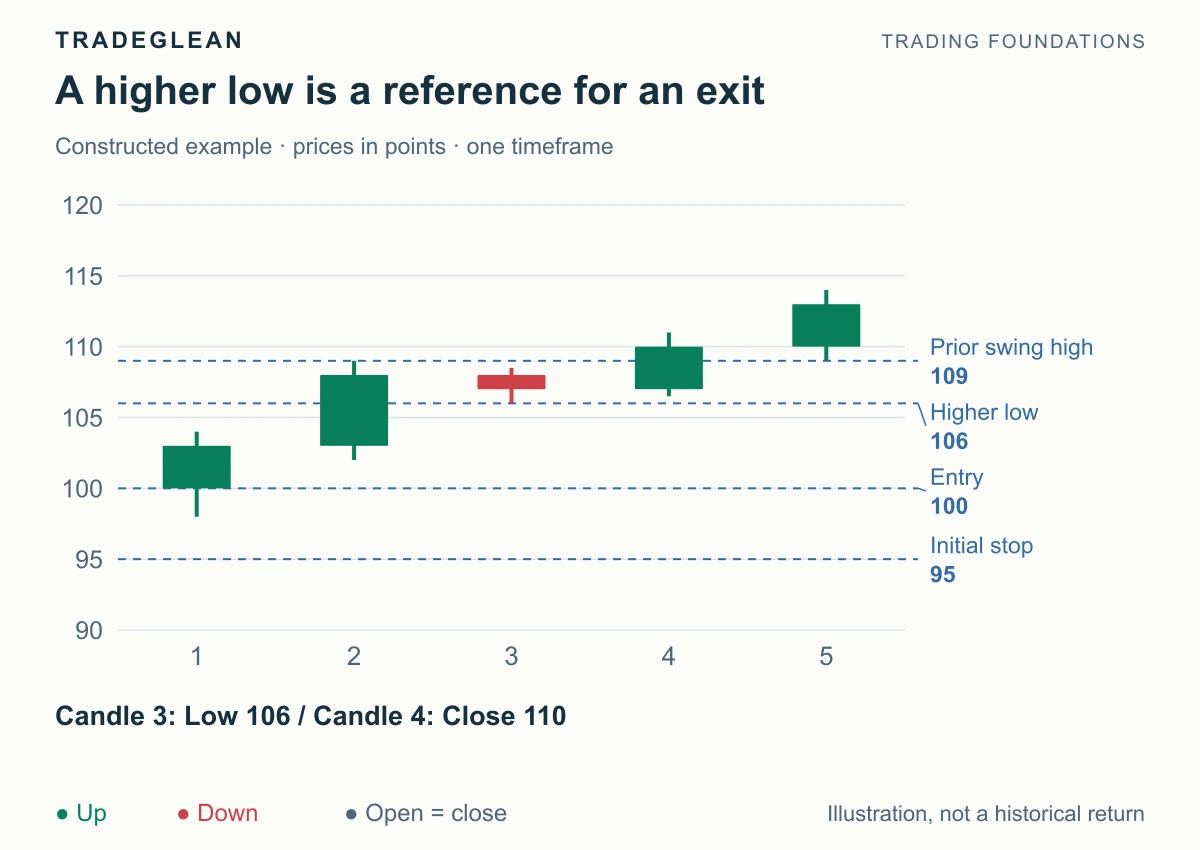
Constructed sequence. The chart illustrates structure-based adjustment, not an automatically calculated trailing order.
Price advances from an assumed 100 entry to a high of 109, then pulls back to 106. That low is only established as a turning point once a rebound develops. A later completed close above 109 provides the confirmation used in this example.
A method can then move protection below the newly confirmed 106 low, with its own stated execution allowance. Until the rebound confirms that pivot, placing a stop immediately beneath the still-forming low uses different evidence. There is no single buffer appropriate to every instrument or timeframe.
An automatic trailing order instead follows the provider's specified distance and reference price. It does not recognize swing structure unless a separate algorithm implements that rule.
Distinguish a pullback from a failed premise
A lower candle inside an upward swing may be ordinary fluctuation. A move through the level that the method explicitly requires to hold is different. For the original 95-based plan, moving the stop farther away to avoid an exit changes the loss exposure; it does not repair the setup.
An adjusted local stop can end a trade while the wider trend remains intact. A new entry would still require a new trigger and position-size calculation. A larger timeframe does not cancel the already executed exit.
When part of a position closes, reduce any remaining exit quantities accordingly and confirm how linked orders behave. A method described as intraday also needs a time exit before its defined holding session ends, even when a target has not been reached. Provider sessions differ, particularly in continuously traded markets.
Use reward and expectancy to understand the effect of these exit choices. The goal of the comparison is to make the rules and possible outcomes explicit, not to claim a universal best exit.